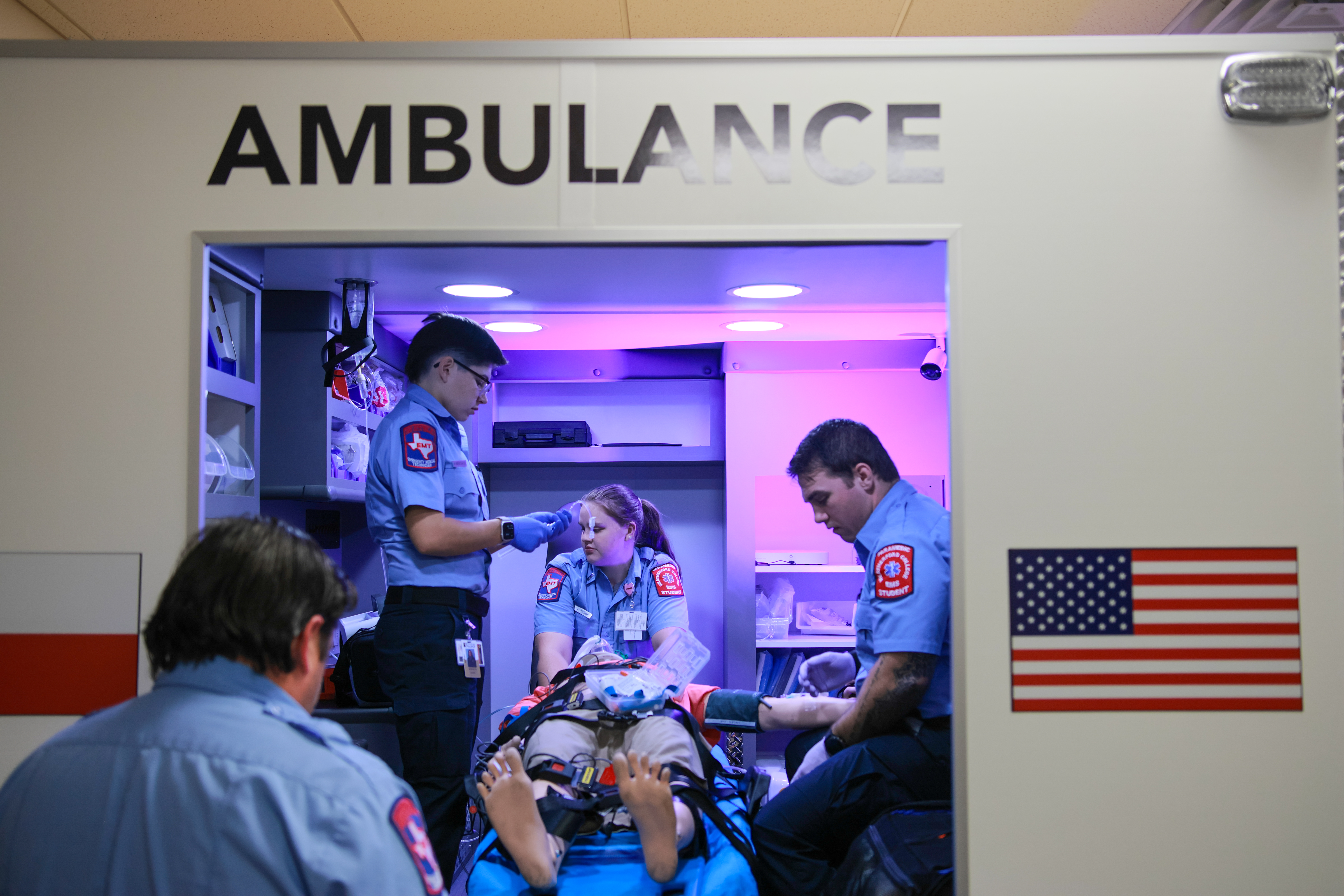
Essential Functions of the Profession
To effectively perform as an EMS Professional, students need to be able to perform certain functions during their training and while employed. The essential functions delineated below are necessary for safe and effective patient care. These skills and abilities are required for program admission, progression and graduation.
Students must be able to perform all of essential qualifications with or without reasonable accommodations. Qualified applicants with disabilities are encouraged to apply to the program if they feel they can meet all of the essential functions. Students with disabilities must request accommodations through the Office of Students Accommodations at Weatherford College to be considered. Students granted reasonable accommodations are still expected to perform all essential functions, and the program is not required to provide requested accommodations that would fundamentally alter the essential functions, of the program and the outlined descriptions.
The essential functions include but are not limited to the ability to:
Sensory and Perception
- See objects up to 20 inches away (computer text, syringe calibrations).
- See objects up to 20 feet away (presence of individuals close by).
- See objects greater than 20 feet away (road signs, house numbers).
- Distinguish color (color-coded supplies) and shading (skin signs).
- Use peripheral vision and depth perception in emergency settings.
- Perceive differences in surface characteristics (palpate anatomic landmarks).
- Read fine print in varying levels of light.
- Read for prolonged periods of time.
- Read at varying distances.
- Read data/information displayed on monitors, equipment, maps and computers.
- Identifies and responds to key audible stimuli including radio traffic, alarms, warning sounds as well as audible findings on the physical exam.
- Detect and discriminate against high and low frequency sounds produced by the body and the environment.
- Discern tremors, vibrations, pulses, textures, temperature, shapes, size, location, and other physical characteristics.
- Perceive odors from faint to noxious (body odors, smoke, gas, alcohol).
- Ability to use the senses to make correct judgments regarding patient conditions and safely administer pre-hospital emergency care.
Communication/Interpersonal Relationships
- Communicate by phone, radio, computer, and other electronic devices.
- Express one’s ideas and feelings clearly.
- Communicate effectively/accurately with fellow students, faculty, dispatch, patients, and members of the healthcare team.
- Be able to send and receive verbal and nonverbal messages.
- Verbally and in writing, engage in a two-way communication and interact effectively with others from a variety of social, emotional, cultural and intellectual backgrounds.
Cognitive/Critical Thinking
- Effectively read, write, and comprehend the English language.
- Consistently and dependably engage in the process of critical thinking in order to formulate and implement safe and ethical decisions in a variety of settings.
- Demonstrate satisfactory performance on written examinations, including mathematical computations without a calculator.
- Satisfactorily achieve the program objectives.
- Comprehend new knowledge and apply it in the practice setting.
- Organize, problem-solve, and make decisions.
- Be able to make good judgment decisions and exhibit problem-solving skills under stressful situations.
Motor Function
- Handle and operate small delicate equipment/objects without extraneous movement, contamination or destruction.
- Move, position, turn, transfer, assist with lifting, or lift and carry patients without injury to patients, self, or others.
- Push/pull heavy objects without injury to patient, self, or others.
- Function with hands free for prehospital care and transporting items.
- Maneuver in small areas.
- Calibrate/use equipment.
- Perform CPR and physical assessment (repetitive motions and upper body movement).
- Have the physical ability to walk, climb, crawl, bend, squat, push, pull, or lift and balance over uneven and less than ideal terrain.
- Have good physical stamina and endurance, which would not be adversely affected by having to lift, carry, and balance at times, in excess of 125 lbs., 250 lbs. with assistance.
- Have good hand-eye coordination and manual dexterity to manipulate equipment, instrumentation, and medications.
- Stand/walk/sit for long periods.
- Ride in all positions in ambulance or response unit without motion sickness.
- Move with sufficient speed to respond to an emergency.
- Maintain balance, sitting and standing, in motion and still.
- Reach above shoulders and below waist.
- Safely and effectively restrain a patient.
- Preserve own safety and assist others in preserving safety.
Behavior and Social
- Demonstrate and value caring, respect, patience, sensitivity, tact, compassion, empathy, tolerance, and a healthy attitude toward others.
- Demonstrate a healthy mental attitude that is age-appropriate.
- Handle multiple tasks concurrently.
- Function effectively in situations of uncertainty and stress inherent in providing prehospital care.
- Report promptly to class and clinical rotations and able to function for up to 24 hours.
- Accepts responsibility, accountability, and ownership of one’s actions.
- Possess sufficient emotional stability to be able to perform duties in life or death situations and in potentially dangerous social situations.
- Be oriented to reality and not mentally impaired by mind-altering substances.
- Work effectively in groups and independently.
- Maintain concentration on situation and tasks as long as necessary.
- Maintain professional demeanor in all interactions and at all times.
- Maintain professional therapeutic boundaries.
- Adapt to sudden, expected, or unexpected change.
- Respond appropriately to stress and other strong emotions, both your own and others’.
- Negotiate interpersonal conflicts to successful resolution.
- Establish rapport with patients, bystanders, and coworkers as appropriate.
- Appreciate and value diversity (social, cultural, spiritual, racial, or other).
- Recognize emotions, both own and others’.
- Provide emotional support to patient and others as appropriate.
- Value and demonstrate honesty, integrity, and justice.
- Demonstrate professional ethics and adhere to ethical standards in all situations.
Mathematics
- Perform accurate measurements (weight, temperature, volume, or time).
- Count events or instances (pulse rate, drip rate).
- Perform arithmetic (add, subtract, multiply, and divide, including fractions).
- Convert numbers to or from the metric system.
- Comprehend graphs and charts.
Environment
- Adapt to changing environments and situations.
- Be able to tolerate being exposed to extremes in the environment including variable
aspects of weather, hazardous fumes and noise.