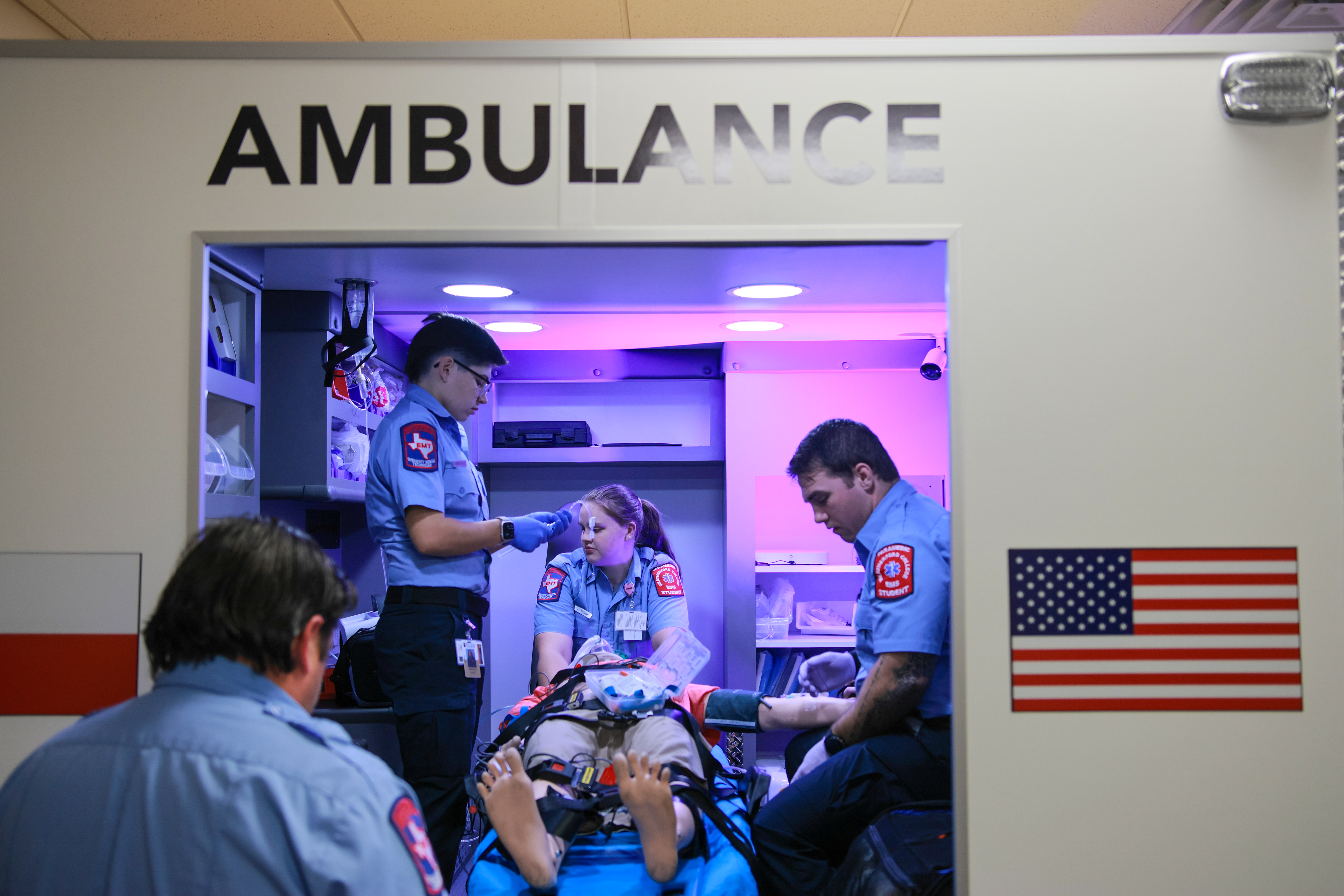
The goal of the Weatherford College Emergency Medical Services Program is to prepare
Emergency Medical Responders, Emergency Medical Technicians, and Paramedics who are
competent in the cognitive (knowledge), psychomotor (skills), and affective (behavior)
learning domains to enter the EMS profession.
People’s lives often depend on the quick reaction and competent care of emergency
medical technicians (EMTs) and paramedics, which are EMTs with additional advanced
training who perform more difficult pre-hospital medical procedures. Incidents as
varied as automobile accidents, heart attacks, drownings, childbirths, and gunshot
wounds all require immediate medical attention. EMTs and paramedics provide this vital
attention as they care for and transport the sick or injured to a medical facility.
Depending on the nature of the emergency, EMTs and Paramedics typically are dispatched
to the scene by a 911 operator and often work closely with police and fire department
personnel. Once they arrive, they determine the nature and extent of the patient’s
condition, while trying to ascertain whether the patient has preexisting medical problems.
Following policies and protocols, they give appropriate emergency care and, when necessary,
transport the patient. EMTs and Paramedics also treat patients with minor injuries
on the scene of an accident or at their home without transporting them to a medical
facility. Some Paramedics work as part of helicopter flight crews that transport critically
ill or injured. All treatments are carried out under the operating guidelines of medical
doctors. In addition, Community Paramedics provide long-term care that addresses public
health, primary care, disease management, social services, and wellness care.
EMTs and Paramedics may use special equipment such as backboards to immobilize patients
before placing them on stretchers and securing them in the ambulance for transport
to a medical facility. Usually, one EMT or Paramedic drives while the other monitors
the patient’s condition and gives additional care as needed. At the medical facility,
EMTs and Paramedics transfer patients to the emergency department staff, report their
observations and actions, and may provide additional emergency treatment. After each
run, EMTs and Paramedics replace used supplies, check equipment, decontaminate the
equipment and the interior of the ambulance, and write a patient care report.
Beyond these general duties, the specific responsibilities of EMTs and Paramedics
depend on their level of qualification and training. The Texas Department of State
Health Services certifies or licenses emergency medical service (EMS) providers and
the National Registry of Emergency Medical Technicians (NREMT) registers providers
at four levels: First Responder, also called Emergency Care Attendant (ECAs), EMT,
Advanced EMT, and Paramedic. The lowest level, First Responder (ECA), is trained to
provide basic emergency medical care because they tend to be the first persons to
arrive at the scene of an incident. Many firefighters, police officers, and other
emergency providers obtain this level of training. The EMT represents the first component
of the emergency medical service (EMS) system. An EMT is trained to care for ill or
injured patients on scene and during transport by ambulance to the hospital. The EMT,
basic life support, has the skills to assess a patient’s condition and manage respiratory,
cardiac, other medical, and trauma emergencies.
Working Conditions
EMS Providers work both indoors and outdoors, in all types of weather. They are required
to do considerable kneeling, bending, and heavy lifting. These providers risk noise-induced
hearing loss from sirens noisy accident scenes and back injuries from lifting patients.
In addition, EMTs and Paramedics may be exposed to communicable diseases such as Hepatitis
and HIV, as well as violence from drug overdose victims or mentally unstable patients.
The work may not only be physically strenuous but also stressful, involving life-or-death
situations and suffering patients. Nonetheless, many people find the work exciting
and challenging and enjoy the opportunity to help others.
EMTs and Paramedics should be emotionally stable, have good dexterity, agility, and
physical coordination, and be able to lift and carry heavy loads. EMTs and Paramedics
employed by fire departments work about 50 hours a week. Those employed by hospitals
frequently work between 45 and 60 hours a week and those in private ambulance services,
between 45 and 50 hours. Some of these providers, especially those in police and fire
departments, are on duty for extended periods. Many EMTs and Paramedics work 24/48
hours shifts in which they work for 24 hours and are off the next 48 hours and 48/
96 in which they work for 48 hours and are off for the next 96 hours. Because emergency
services function 24 hours a day, EMTs and Paramedics have irregular working hours
that add to job stress.
Formal training and certification are needed to become an EMT or Paramedic. In Texas,
an applicant must complete a Department of State Health Services-approved course,
and pass a credentialing exam and a skills exam. All initial applicants will be required
to take the National Registry of EMTs examination to obtain a Texas certification
or licensure. To maintain certification, EMTs and Paramedics must reregister, every
2 years for the National Registry, and/or every four years for the Texas Department
of State Health Services. To re-register or recertify, an individual must meet the
continuing education requirements set by the issuing entity.
Training is offered at progressive levels: EMT, Advanced EMT, and Paramedic. The EMT
represents the first level of skills required to work in the emergency medical system.
Formal classroom experiences are enhanced with combined time in an emergency room
and an ambulance. Coursework typically emphasizes emergency skills such as managing
respiratory, trauma, and cardiac emergencies and patient assessment. The program also
provides instruction and practice in dealing with bleeding, fractures, airway obstruction,
cardiac arrest, and emergency childbirth. Students learn to use and maintain common
emergency equipment, such as backboards, suction devices, splints, oxygen delivery
systems, and stretchers. The course is a prerequisite for further training as an Advanced
EMT and Paramedic. Advanced EMT training requirements vary from State to State.
The most advanced level of training for this occupation is paramedic. At this level,
the caregiver receives additional training in physiology, pharmacology, patient assessment,
cardiology, trauma, airway management, and extensive training in other body systems.
Paramedic coursework lasts eleven to twenty-four months and can result in an associate
degree in applied science. Such education prepares the graduate to take the NREMT
and/or the State Credentialing Examination and become certified as a Paramedic. Extensive
classroom, clinical, and field training is required. Due to the longer training requirement,
almost all Paramedics are in paid positions. Refresher courses and continuing education
are available for EMTs and Paramedics at all levels.
Advancement beyond the paramedic level usually means leaving fieldwork. A Paramedic
can become a supervisor, community Paramedic, flight Paramedic, operations manager,
administrative director, or executive director of emergency services. Some EMTs and
Paramedics become educators, or dispatchers, while others move into sales or marketing
of emergency medical equipment. Several people become EMTs and Paramedics to assess
their interest in healthcare and then decide to return to school and become registered
nurses, nurse practitioners, physician assistants, physicians, or other healthcare
providers.
Students or prospective students with disabilities can contact the Office of Disabilities
and Accommodations. The Office of Disabilities and Accommodations exists to assist
students with documented disabilities as they pursue their goal of a college education.
The office serves as a liaison between students and the college in matters of communication
and action toward the achievement of reasonable accommodations. Each student is encouraged
to act as his or her advocate and take the major responsibility for securing accommodations.
The Office of Disabilities and Accommodations provides students with the voluntary
and confidential means to seek accommodations for academic and related needs. Early
and regular contact will ensure the timely identification of needed services and the
location of resources and options available to the student.
Eligibility for disability services at Weatherford College is dependent upon the nature
of the disability and its impact on learning. A disability is defined as any mental
or physical condition that substantially limits an individual’s ability to perform
one or more major life activities. These disabilities may be: physical, visual, or
auditory, neurological, or psychological in nature, and also include chronic health
problems and learning and communication disorders.
Due to the high volume of students who receive services through this office, it is
highly recommended that students make appointments with the counselor in the Office
of Disabilities and Accommodations located in Student Services or call 817-598-6350.
Disability Services at WC